
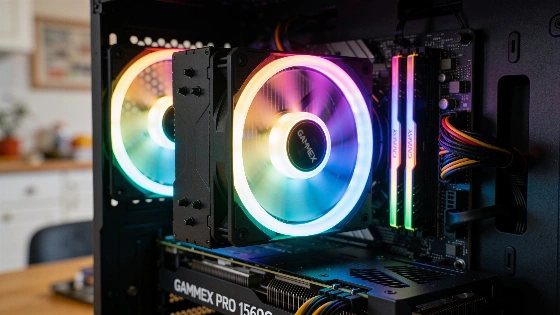
Gamemax RGB PRO 750G nails efficiency and ripple control, but its loud fan and steep price make the RGB lighting the only real reason to pick it over quieter, certified Gold rivals.
Buyers looking for a new power supply have no shortage of options. Gamemax throws its RGB PRO 750G into the mix with promises of high efficiency, low ripple, and a 10-year warranty. The big selling point? A bright ring of addressable RGB lighting. But the numbers behind the glow tell a different story for anyone expecting more than just looks for €105.
The price stands out right away. At €105, the RGB PRO 750G costs much more than the MSI MAG A750GL PCIE5 and Corsair RM750e. Those two usually sell for about €80. Both have public Gold certification and run quieter under load. Cooler Master's MWE Gold 750 V4 is about €119. It matches Gamemax's warranty and lists its components more clearly.
Prestazioni elettriche e rumorosità
On the technical side, the RGB PRO 750G does its job. Efficiency averages 90.8% at 230 VAC and 88.6% at 115 VAC. Ripple stays well below ATX limits. Voltage regulation is tight on all rails. The main Nichicon capacitor is a plus. Internal temps stay in check, even at full load. The main heatsink hits 51°C in cold tests and 80.8°C in hotbox runs. Tom's Hardware measured peak efficiency at 92.1% around 40% load on 230 VAC. That's in line with 80 Plus Gold standards, but it doesn't beat the competition or offer a clear edge.
The fan is a different story. There's no semi-passive mode. It spins all the time and ramps up fast above 300 watts. Noise hits 43 dB(A) at 525 watts. At full load, it nearly reaches 50 dB(A). That makes this one of the loudest parts in any gaming or rendering PC. In hotbox tests, the fan gets even louder, peaking at 54.4 dB(A). For anyone who wants a quiet build, this is a dealbreaker.
The RGB PRO 750G is two products fighting each other: a technically decent platform paired with an unconvincing overall execution and price.
Design e funzionalità
The RGB PRO 750G looks sharp. The addressable lighting ring sits under the fan grille and gives off a smooth, even glow. No harsh LED hotspots like you see on cheaper strips. A button on the back cycles through 25 lighting modes and remembers your last setting after shutdown. But there's a catch. The lighting only shows if the power supply is mounted fan-up. In most cases, it hides behind a shroud. The effect disappears.
The unit is longer than standard ATX by 25 millimeters. That can make cable management tricky in mid-tower cases. All cables are fully modular and sleeved in black braid. They're stiffer than flat cables and need more space behind the motherboard tray. The box includes every connector you'd expect, including a native 12V-2x6 for PCIe 5.1. The 10-year warranty matches top brands. The main capacitor is Nichicon, but the secondary ones are Teapo. They're rated for 105°C but don't match the best Japanese brands.
Certificazioni e protezioni
Gamemax says the unit is 80 PLUS Gold. Test results back this up, but just barely. It meets Gold at all checkpoints, but the margin is thin. There's no public certification for this model in the CLEAResult 80 PLUS, Cybenetics, or PPLP databases. Buyers have to trust Gamemax's word. The badge is a claim, not an independently verified fact. That's a problem. Italian and EU regulators like MIMIT are pushing for more transparency and proof of efficiency and safety in consumer electronics.
Protection circuits work as they should. But the 12-volt over-current protection is set tighter than on many ATX 3.1 units. It trips at 108% of the rated 62 amps. That leaves less room for modern graphics cards, which can spike above their rated draw. Sudden shutdowns are possible during power spikes. Over-power protection kicks in at 110% of rated output. Using this supply with a high-end GPU running close to 750 watts is risky.
Confronto con la concorrenza
Gamemax's ads push the "Japanese capacitor" angle. In reality, only the main capacitor is Nichicon. All the rest are Teapo, rated for 105°C but a lower tier. The fan is called fluid dynamic, but there's no proof from the model number. No semi-passive mode. The fan curve is aggressive. The RGB PRO 750G is louder and less documented than its rivals.
If you care about looks, the RGB lighting is a real feature-if your case shows it. For buyers who want performance, value, and silence, the price is hard to swallow. As reported earlier, flashy features only matter if you can see them and they add real value.
The RGB PRO 750G is technically solid. It's efficient, keeps ripple low, and comes with a 10-year warranty. But it's loud, its Gold certification isn't verified, and its protection limits are tight. At €105, that's a tough sell. The RGB lighting is the only real reason to pay more-and only if you can actually see it in your build. For most, a quieter, certified supply is the smarter buy.