
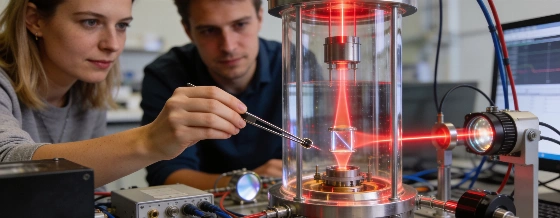
QuEra has doubled the world record for logical qubits using neutral atom technology while Atom Computing and Pasqal shift the industry focus from raw qubit counts to error-corrected performance. The neutral atom approach is now challenging established quantum hardware leaders.
Forget the old scoreboard of quantum computing. In early 2026, QuEra's neutral atom platform shattered expectations by verifying 96 logical qubits-doubling its own previous record and compressing the physical-to-logical qubit ratio to an unprecedented 5:1. This leap, achieved with just 448 physical atoms, has forced the industry to confront a new reality: the era of headline-grabbing raw qubit counts is over. The only number that matters now is how many logical, error-corrected qubits a system can deliver in practice.
QuEra's feat is not an isolated technical flourish. Atom Computing and Pasqal, the other two titans of neutral atom quantum hardware, are executing parallel strategies that sidestep the limitations of superconducting and trapped-ion systems. Atom Computing's Magne system, set for deployment in Denmark in 2027, will be the first commercial quantum computer sold by its logical qubit count-targeting 50 error-corrected units from 1,225 physical qubits. Pasqal, meanwhile, is embedding its neutral atom processors directly into European supercomputing centers, with a roadmap that promises 100 high-fidelity logical qubits by 2029 and a transition from analog to fully digital, gate-based architectures.
La nuova metrica: dal qubit fisico al qubit logico
For years, quantum hardware vendors have competed on the size of their physical qubit arrays. But as QuEra, Atom Computing, and Pasqal now demonstrate, the real bottleneck is not how many qubits you can trap, but how many you can keep stable, entangled, and error-corrected long enough to run meaningful algorithms. Neutral atom systems have upended the ratios: where superconducting qubits require roughly 1,000 physical units for each logical qubit, and trapped ions hover near 2:1, QuEra's latest results show a 5:1 ratio-an order-of-magnitude improvement that is already reshaping commercial roadmaps.
This shift is not just academic. Atom Computing's decision to market Magne by logical qubit count, not physical, signals a new commercial logic. Microsoft's Azure Quantum stack, tightly integrated with Atom's hardware, is designed to exploit this advantage, with a 2025 whitepaper outlining a tenfold increase in qubit count per generation. Pasqal's public roadmap is even more explicit: Vela (2026) at 256+ qubits, Centaurus (2028) at 10,000 physical qubits and early fault tolerance, Lyra (2029) at 100 logical qubits, and a 2030 target of 200+ logical units. The message is clear-logical qubits are the new currency of quantum progress.
Perché gli atomi neutri stanno vincendo la corsa
Neutral atom quantum computing is not just a numbers game. The technology's core advantage lies in its atomic uniformity and reconfigurability. Every rubidium-87 atom is physically identical, eliminating the calibration headaches that plague superconducting chips. The architecture is software-defined: optical tweezers can shuttle atoms into new configurations mid-computation, enabling dynamic connectivity and parallel gate operations that fixed-wire competitors cannot match.
QuEra's gate-based, zoned architecture-dividing the atom array into storage, entangling, and readout regions-makes mid-circuit measurement and real-time error correction practical. Atom Computing's use of strontium atoms, with their superior resistance to magnetic field noise, has pushed coherence times into the tens of seconds. Pasqal's analog approach, programming the physics of the entire array for specific optimization and simulation tasks, has already delivered quantum advantage in materials science simulations for clients like EDF and Thales.
Even the main technical challenge-atom loss from the optical trap-has become a manageable engineering problem. Erasure errors are instantly detected and corrected by loading fresh atoms from a reservoir, with error-correcting codes reconstructing the logical state. This is a level of operational resilience that other modalities still struggle to match.
Le aziende e le loro strategie
QuEra, spun out of Harvard and MIT, has raised over $507 million and secured backing from Google Quantum AI, SoftBank Vision Fund, and NVIDIA NVentures. Its Aquila system on Amazon Braket remains the most-used neutral atom platform, and its Libra system-targeting 256 logical qubits at "megaquop scale"-is set for cloud launch in 2028. Google's simultaneous investment in QuEra and launch of its own neutral atom program in Boulder is a rare double endorsement from a company still running its superconducting Willow chip in production.
Atom Computing, founded in Berkeley, has locked in over $300 million and a strategic partnership with Microsoft. Its 1,180-qubit array set a world record in 2023, and its Magne system will be the first to deliver logical qubits as the primary commercial specification. The company's collaboration with Nu Quantum aims to network separate atom arrays via photonic links, a necessary step for scaling beyond single-module limits.
Pasqal, founded by Nobel laureate Alain Aspect, is the commercial deployment leader. With systems installed at GENCI, Forschungszentrum Jülich, and CINECA, and €16.5 million in 2025 bookings, Pasqal is already serving enterprise clients in finance, energy, and logistics. Its acquisition of Aeponyx signals a push to replace bulky laser optics with chip-scale photonic components, addressing both control precision and manufacturing scalability.
Impatto e prospettive per l'Europa e l'Italia
Pasqal's integration into European HPC centers and Atom Computing's Nordic deployment are not just technical milestones-they are strategic moves that position Europe as a key battleground for quantum advantage. Italian research institutions and enterprises now have direct access to neutral atom hardware, bypassing the need for specialized cryogenic infrastructure. The shift from physical to logical qubit metrics will force Italian and European policymakers to rethink funding priorities and procurement criteria for quantum technologies.
As the neutral atom field accelerates, the consequences ripple far beyond the lab. The rapid pace of progress-256 physical qubits on AWS in 2022, 96 logical qubits in 2026, and commercial logical-qubit systems by 2027-was not anticipated even two years ago. The industry's pivot to error-corrected, deployable systems is as significant as the previous investigation into blockchain vulnerabilities: both mark a shift from theoretical promise to operational reality.
La posizione dell'autore
The neutral atom quantum computing sector has outpaced its rivals by delivering not just more qubits, but more usable, error-corrected computation. The combination of atomic uniformity, software-defined connectivity, and practical error correction has moved this technology from the realm of physics experiments to the threshold of commercial deployment. The fact that Google is hedging its bets-investing in QuEra while running its own neutral atom program-signals that even the most entrenched players see the writing on the wall. The next two years will determine whether neutral atoms can sustain this momentum and deliver the first real-world quantum advantage. For now, the evidence is clear: the neutral atom approach is no longer a dark horse. It is the new standard by which all quantum hardware will be measured.