
AMD's Ryzen 7 7700X3D arrived in stores with little publicity and no review samples, but independent testing shows it matches the 7800X3D in gaming for much less money. The FPS Review's hands-on benchmarks reveal a new price-performance leader for the AM5 platform.
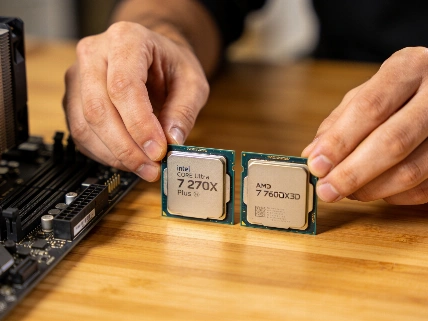
AMD released the Ryzen 7 7700X3D with almost no publicity and didn't send out review samples, a move that seemed designed to keep attention on the more expensive 7800X3D. That plan didn't last. The FPS Review bought a retail 7700X3D and tested it directly against the 7800X3D. The difference in gaming performance turned out to be so small that the €120 price gap became the real story.
In gaming tests, the 7700X3D's average frame rates were usually just 1 percent behind the 7800X3D, with the biggest gaps rarely reaching 7 percent. Even the 1 percent lows-often the toughest measure of a CPU's consistency-never fell more than 8 percent behind. For most gamers, these differences are impossible to notice in actual play. Both chips have 8 cores, 16 threads, Zen 4 architecture, 96MB of 3D V-Cache, and the same power limits. The main difference is that the 7700X3D runs at slightly lower base and boost clocks.
Official specs list the Ryzen 7 7700X3D as an AM5 Zen 4 processor with 8 cores, 16 threads, 96 MB of L3 cache, a 4.0 GHz base clock, 4.5 GHz boost clock, and a 120 W TDP. It matches the 7800X3D in architecture but runs at lower frequencies. AMD announced the chip at Computex 2026, and it reached European stores in July 2026, weeks before the usual review cycle. Early retail prices in Europe have already dropped below MSRP, with some listings showing the 7700X3D at about €317, reflecting quick discounts and strong demand.
Side-by-side benchmarks consistently show the Ryzen 7 7700X3D delivering gaming performance nearly identical to the 7800X3D, despite its lower clock speeds and reduced price point.
Outside of games, the 7700X3D falls behind by 5 to 7 percent in single- and multi-core productivity tasks. But at a $329 suggested price-about 27 percent less than the 7800X3D's $449 launch price-the trade-off is hard to ignore. By adding a new X3D chip to the AM5 lineup during the Zen 5 era, AMD is clearly trying to keep the platform relevant and give builders more reasons to stick with it.
This week's hardware reviews covered more than just CPUs. The FPS Review looked at two ASUS X870E motherboards released days apart, showing how quickly the platform is evolving. The Phanteks EX5 Max case, with its unusual partitioned layout, picked up an innovation award, while Fractal's new Summit enclosure didn't live up to the brand's earlier models. GamersNexus declined to recommend the new Fractal case, pointing out that not every new product is worth buying.
Peripheral and monitor reviews also filled the week. The Alienware AW3926QW and Koorui G2741L monitors were tested for panel quality and features. The ASUS ROG Azoth Extreme Edition 20 keyboard, MSI FORGE GM340 Wireless mouse, and PowerColor ALPHYN AM10 Wireless Gaming Mouse all got hands-on reviews. Even the Fractal Design Refine 2 gaming chair and Antec Flux Rear case were put through their paces, highlighting the constant stream of new hardware and the need for independent testing.
For those following compact desktops, the GEEKOM IT13 MAX mini PC recently set a new standard for connectivity and value. But with the 7700X3D's arrival, attention is shifting back to mainstream gaming builds and the future of the AM5 platform.
AMD's choice not to send out 7700X3D review samples looks less like an oversight and more like a bet that buyers would pay extra for the 7800X3D's small advantage. The FPS Review's independent testing has called that bet: for most gamers, the 7700X3D is the better deal, offering nearly the same gaming performance for much less money. AMD's strategy may frustrate reviewers, but for buyers, it's a rare win-proof that value can still shake up even the most carefully managed product lines.
For more on processor compliance and market introduction, see the MIMIT official innovation portal.