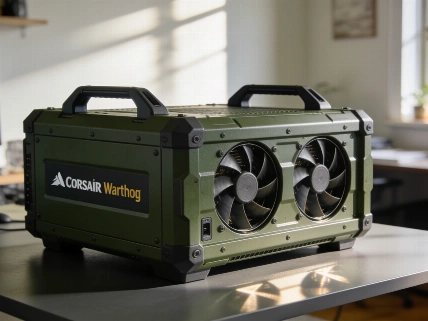

Corsair's Warthog RS brings back the Vengeance C70's steel, handles, and tactical style, but now with modern cooling, modular rails, and a unique I/O. Does its throwback design and price make sense in 2024?
The Corsair WARTHOG RS doesn't try to blend in. It ditches the glass and RGB for a steel, military-inspired look that stands out. This case is for people who want something different. It calls back to the old Vengeance C70, famous for its ammo-crate style and built-in handles. But Corsair knows nostalgia isn't enough in 2024. The WARTHOG RS aims to prove that tough looks and smart engineering can work together. It makes some bold choices along the way.
There's more to the WARTHOG RS than just its looks. Under the thick steel and Olive Drab paint, Corsair uses the FRAME 4000D's chassis. It adds InfiniRail fan mounts, a RapidRoute 2.0 pegboard tray, and support for reverse-connector motherboards from ASUS, MSI, and GIGABYTE. The RS version comes with two 200mm RS200 intake fans and a 120mm RS120 exhaust already installed. The standard WARTHOG leaves airflow up to you.
Features that matter
The WARTHOG RS is big for a mid-tower. It measures 546 × 284 × 534 mm and fits Mini-ITX to E-ATX boards, including new reverse-connector models like ASUS BTF, MSI Project Zero, and GIGABYTE Project Stealth. GPUs up to 405mm fit with the front fans in place. The expansion slot bracket rotates for vertical GPU mounting, but you'll need to buy a PCIe riser. Storage is basic: two 2.5-inch drives and one 3.5-inch, though Corsair offers a 3D printable HDD cage if you need more.
Cooling is where the WARTHOG RS goes all in. Out of the box, you get 2× RS200 200mm intake fans and 1× RS120 120mm exhaust. You can add up to 9 more 120mm fans or 5 more 140mm fans. Triple-fan radiators fit in the front, top, and side. Custom loop builders get fill and drain ports already punched out. The InfiniRail system lets you slide rails to fit any fan size, so you're not stuck with one setup. The front I/O stands out: power, reset, and rear-light switches sit behind metal guards, the reset button hides under a flip-up cover, and a "Remove Before Build" tag nods to aviation gear. The rear I/O light is a real upgrade-no more guessing where your cables go in the dark.
The WARTHOG RS offers excellent cooling right out of the box, thanks to its large 200 mm intake fans and RS120 exhaust, making it easier to build a high-performance, low-noise system.
The handles aren't just for looks. Corsair says they're strong enough to lift a fully built system. The top nylon strap is only for removing the panel-ignore the warning and you'll regret it. The left side panel mixes tempered glass and steel, but the window is small on purpose. Most of your hardware stays hidden. If you want to show off every RGB part, this isn't your case. The right panel is solid steel with a magnetic dust filter. Both sides use a tilt-and-clip system that keeps panels secure, even when they're open during a build.
Inside, the RapidRoute 2.0 tray with pegboard holes and 50mm of cable space makes for a tidy build. The Nano GPU anti-sag arm is a nice touch, though you might need to remove it for E-ATX boards. The case is made for Corsair's SHIFT side-connector PSUs, and the front Type-C port gives you full 20Gbps speeds if your motherboard supports it. Dust filters cover the front, side, and bottom. Corsair backs the case with a two-year warranty.
Pros and cons, no filter
The WARTHOG RS delivers on its promise of useful, tactical features. The rear I/O light is a highlight. The guarded switches stop pets or stray knees from hitting reset by accident. Cooling options are unmatched for a mid-tower, with three spots for triple-fan radiators and mounting points in six zones. The InfiniRail system makes upgrades easy-no drilling or new case needed.
But there are trade-offs. The standard WARTHOG comes with no fans, which is tough for a case that's supposed to focus on airflow. The RS model fixes this, but neither version includes a fan hub or lighting. The small side window will disappoint anyone who wants to show off their build. Removing the top panel takes several steps and feels awkward compared to the rest of the design. The front door swings open for cleaning, but taking it off completely needs tools.
Looking back and at the market now
If you remember the Vengeance C70, the WARTHOG RS is a clear nod to that era-when steel, handles, and utility mattered more than glass and LEDs. Multiple independent reviews agree: the WARTHOG is a modern take on the C70 "ammo-crate" idea, not a brand-new concept. Corsair admits LAN parties are mostly gone, but the handles stay as a tribute to the case's roots. The military theme isn't just for show. The design choices set it apart from the generic mesh cases everywhere. As reported earlier, Corsair's move away from glass and RGB is a calculated risk, betting that personality and practicality will win over new builders.
The WARTHOG RS isn't for everyone. If you want a full glass side or plug-and-play RGB, look elsewhere. If you already have good fans, the standard WARTHOG might make sense, but for most, the RS is the better pick-it comes with airflow sorted, so you can spend your money on other upgrades. The price and quirks only make sense if you care about the style and engineering. The WARTHOG RS launches in Europe at €229.90, in the UK at £199.99, and in the US at $199.99. That puts it firmly in the premium mid-tower range.
In a market full of lookalike cases, the Corsair WARTHOG RS stands out. It's bold, built for people who want their PC to look ready for action, not just for show. It has some flaws-no fans in the base model, a small window, and tricky top panel access-but it brings a mix of nostalgia and modern features that few can match. For builders tired of the glass box trend, the WARTHOG RS finally gives both personality and performance a real shot.