

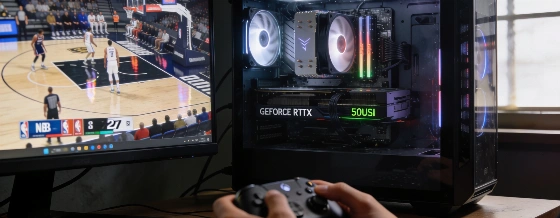
NVIDIA DLSS 5 lands in NBA 2K27 with 3D-Guided Neural Rendering, delivering photorealistic lighting and materials but slashing frame rates by over 60 percent unless Multi Frame Generation is enabled. The technology sets a new bar for realism but demands top-tier hardware and power.
Photorealism in real-time gaming just crossed a new threshold, but the price is steep. With the debut of DLSS 5 in NBA 2K27, NVIDIA has delivered visuals that rival Hollywood productions-at the cost of a dramatic drop in performance that will force even high-end PC gamers to rethink their settings.
DLSS 5's 3D-Guided Neural Rendering is not a minor upgrade. By leveraging AI to analyze every rendered frame, object, and motion vector, it reconstructs lighting and materials with a fidelity previously unseen in sports titles. Subsurface skin scattering, intricate hair detail, contact shadows, and ambient occlusion now appear with a realism that makes digital athletes look uncannily lifelike. Ray-traced reflections on the court surface capture the ball, rim, net, and even the crowd with a level of detail that blurs the line between simulation and broadcast footage.
Prestazioni sotto pressione
But this leap in visual quality comes at a punishing cost. Enabling DLSS 5 on a GeForce RTX 5080 drops NBA 2K27's 4K frame rate from 145 FPS (using native DLAA) to just 50 FPS. That's a 60-65% performance hit-enough to make even flagship GPUs sweat. The only way to claw back smooth gameplay is to activate Multi Frame Generation, which can push frame rates back up to 170 FPS, but at the expense of increased power draw-expect your GPU to pull an extra 100W under load.
For players chasing both beauty and speed, this is a stark trade-off. DLSS 5's neural rendering is so computationally intensive that it effectively locks out older hardware and makes 8GB VRAM the bare minimum for entry. The technology is currently exclusive to the GeForce RTX 50 Series, and even then, only with the latest drivers and game patches.
Controllo creativo per gli sviluppatori
Developers aren't left out of the equation. DLSS 5 offers granular control over its neural rendering pipeline, with per-pixel uplift masks and adjustable sliders for Structure Intensity and Tone Intensity. This means studios can fine-tune the effect to match their artistic vision, enhancing lighting and material realism without altering the underlying geometry. The result is a toolkit that rewards those aiming for photorealism, but offers little to stylized or retro-inspired projects.
NBA 2K27 serves as the proving ground for this technology, and the results are impossible to ignore. Player models exhibit skin translucency and shadow interplay that would have been unthinkable just a generation ago. The court's reflective surface now mirrors the action with uncanny accuracy, and even the crowd benefits from improved rendering-though the focus remains firmly on the athletes and the ball.
Un nuovo standard con un prezzo elevato
DLSS 5 is not for the faint of heart or the underpowered rig. It sets a new standard for real-time rendering, but demands the latest hardware and a willingness to accept higher energy consumption. For now, it's a glimpse into the future of gaming graphics-one where AI-driven neural rendering redefines realism, but only for those ready to pay the price in watts and silicon. NVIDIA has thrown down the gauntlet, and the rest of the industry will have to decide whether to chase this level of fidelity or prioritize performance and accessibility. As it stands, DLSS 5 is both a technical marvel and a clear signal that the era of brute-force graphics is giving way to the age of neural computation-where every frame is a calculated gamble between spectacle and speed.