
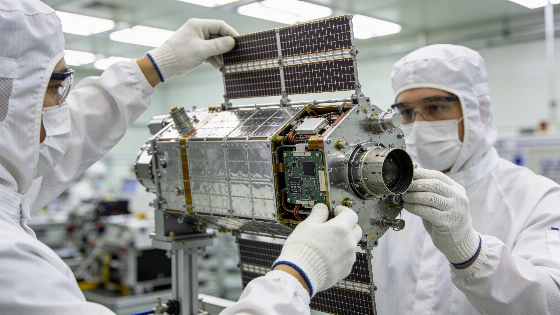
Starcloud plans to mine Bitcoin in sun-synchronous orbit by 2027, chasing near-constant solar power. But the realities of cooling hardware in space and the huge cost of getting there could wipe out any savings on electricity.
Starcloud is betting that the next big move for Bitcoin mining isn't a far-off hydro dam or a Siberian gas flare. It's space. The company wants to send a satellite into sun-synchronous orbit and mine Bitcoin where sunlight barely stops and there's no power grid to worry about. The idea is bold. But the physics and the money are even tougher than anything on Earth.
Heat, not cold, is the real problem
People think space is cold, but that's not how it works for mining. In orbit, there's no air to pull heat away. Every watt burned by a Bitcoin ASIC has to leave through radiator panels, which dump heat as infrared into empty space. The more mining gear you pack into a satellite, the more radiator mass you need. That eats up your payload. On Earth, fans and liquid cooling do the job. In space, every gram matters, and radiator design turns into a fight between mining power and keeping the hardware alive.
Solar power is free, but launch costs are brutal
Sun-synchronous orbit gives you almost nonstop sunlight. That's a dream for any operation that needs a lot of power. But as CEO Philip Johnston points out, miners on Earth can already get electricity for two to three cents per kilowatt-hour, especially from gas flaring. For Starcloud, sunlight costs nothing, but getting the hardware up there is anything but cheap. Launch, building the spacecraft, keeping it connected, and swapping out old hardware all cost money before you mine a single satoshi. The numbers are harsh: orbital mining has to beat the world's cheapest electricity, not just survive in space. According to recent technical reporting, Starcloud's plan is to go head-to-head with the lowest-cost miners on Earth, not just average retail rates.
We'll be the first to mine Bitcoin in space, deploying ASIC miners on Starcloud-2 after it reaches orbit. This is not just a demonstration-our goal is to prove that orbital mining can be commercially viable against the world's cheapest energy sources.
Hardware and obsolescence in orbit
Starcloud's first move was a tech demo. In November 2025, the company sent an Nvidia H100 GPU into orbit on Starcloud-1 to show that compute hardware can work in space. The next mission, Starcloud-2, will go further with GPU computing, storage, and its own power and cooling systems. Bitcoin-mining ASICs will be just one part of the payload. Johnston has compared the price of a B200 GPU (about $30,000) to an ASIC (about $1,000), both using about one kilowatt. But the real test isn't the price tag. It's whether the ASICs can stay profitable as network difficulty rises and hardware gets old. On Earth, swapping out miners is easy. In orbit, it's a headache. Starcloud-2 is a multipurpose satellite, also carrying NVIDIA Blackwell GPUs and AWS server modules. It's a mix of crypto mining and orbital computing in one platform.
Not just Bitcoin: Google is chasing orbital solar too
Starcloud isn't alone. Google's Project Suncatcher is looking at satellite constellations with TPUs for machine learning, using free-space optical links to connect them. Google is focused on AI, not Bitcoin, but the logic is the same. Constant solar power, with no weather or grid failures, could power high-intensity computing-if the numbers work out.
The real test comes in orbit
For Starcloud, the 2027 launch is more than a tech demo. To move past a proof of concept, the mission has to run for the long haul, keep its hardware cool, stay connected, and-most of all-make money after all the launch and hardware costs. If even one of these fails, orbital mining stays a science project, not a business. The next few years will show if Starcloud's vision can survive the realities of space, or if the dream of mining Bitcoin above the clouds will get shut down by the same physics and market math that have stopped others. The industry is watching, but in the end, thermodynamics and economics will decide.