

Can a $380 mini PC really replace a $2,000 desktop for daily work? The Acemagic K5, with its Intel Core 3 304 and dedicated AI NPU, delivers enough power and flexibility to make even high-end PC owners reconsider their setup.
What do you actually lose when you swap a $2,000 desktop for a $380 mini PC? With the Acemagic K5, the answer turned out to be: not much, at least for everyday work. This small box, built around an Intel Core 3 304 and a dedicated AI NPU, handled the usual office routine-web browsing, file transfers, and even some light photo editing-without any real hiccups.
The K5 comes with 12GB of LPDDR5-5600 RAM and integrated Intel Xe graphics. That was enough to keep several browser tabs and productivity apps open at once, and the switch from a high-end desktop felt surprisingly smooth. The processor uses Intel's Wildcat Lake architecture, with one performance core and four efficient cores, plus a 6 MB L3 cache. Multitasking stayed responsive throughout.
Small size, full desktop features
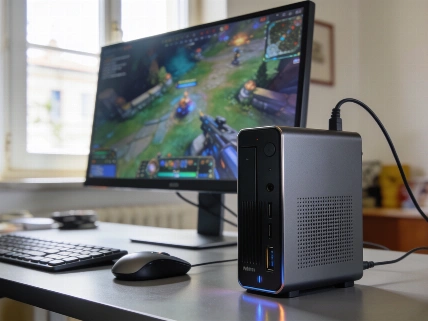
The K5 is tiny-about half the size of a typical graphics card-but still manages to fit in seven USB ports (including a 20Gbps USB-C with DisplayPort 1.4 and 100W USB-PD), HDMI 2.0, DisplayPort 1.4, 2.5GbE, and Wi-Fi 6. The silver plastic case is plain, but the build inside is solid. A heatsink and fan keep the 15W CPU cool, even under load. After ten minutes of stress testing, the CPU held steady at 72°C, and during normal use, it rarely went above 60°C.
Performance numbers back this up. In Geekbench and 7-Zip, the K5 scores about the same as recent laptops. It can run up to three 4K 60Hz displays at once. Windows 11 Pro comes preinstalled, and the whole unit weighs less than 2 pounds, so it's easy to move or tuck away. Bluetooth 5.2 and a generous set of ports are unusual at this price, making it flexible for both wired and wireless setups.
The dedicated NPU is what sets the K5 apart from most mini PCs. While it doesn't hit the 40 TOPS needed for Copilot+ PC branding (and its 12GB RAM is below the 16GB minimum), the NPU still delivers up to 15 TOPS, or 24 TOPS when combined with the integrated GPU. This makes it a practical way to try out local AI workloads, with support for OpenVINO, Windows ML, ONNX Runtime, and WebNN. For anyone curious about machine learning or light AI tasks, the K5 offers hardware that most budget PCs skip entirely.
That's a different approach from the GMKtec EVO-X3, which is aimed at advanced users and comes with workstation-level specs. The K5 brings AI acceleration to a wider audience at a much lower price.
Everyday use and gaming
After several days of real-world use, the K5 never felt slow. Office work, web browsing, and photo editing in GIMP all ran smoothly. The 12GB of RAM was enough for multitasking, though it's soldered and can't be upgraded. The included NVMe SSD-a Colorfire CF620 PCIe Gen 3 x4-was fast enough to max out a gigabit network connection, and there's a second M.2 slot for more storage if needed.
Gaming isn't the K5's main purpose, but it can handle lighter titles. Forza Horizon 6 ran at 17 FPS on very low settings at 1080p, Minecraft reached 116 FPS at 1440p, Vampire Survivors hit 238 FPS, and Hades II managed 38 FPS at 1440p low. It won't replace a gaming PC, but it's fine for casual games.
Trade-offs and where the K5 fits
No device at this price is perfect. The biggest limitation is the non-upgradeable 12GB RAM, which could be a problem for heavy multitaskers or those wanting to run larger AI models. The SSD is decent but not high-end. Some older AMD-based mini PCs offer better integrated graphics and multi-threaded performance for similar money, but the K5's hybrid design-with one performance core and four efficient cores-strikes a good balance between responsiveness and background tasks, all while keeping power use low. The processor's base power is 15W, with a max turbo of 35W, making it a good fit for energy-conscious users and compliant with European eco-design rules.
Compared to other compact PCs, like those in our previous coverage, the K5 stands out for its AI hardware and aggressive sale pricing, often beating rivals with similar specs. For buyers in Italy, Wi-Fi 6 and 2.5GbE networking mean it works with the latest broadband standards and matches AGCOM broadband guidelines for next-gen connections.
Editorial view: a new baseline for office PCs
The Acemagic K5's current sale price-$380 for the 256GB model, $400 for 512GB-makes it a strong contender in the mini PC market. It outpaces older Intel and AMD machines with faster memory and a dedicated NPU, and offers enough ports and cooling for most office needs. If you don't need workstation-level power or upgradable RAM, the K5 is a real alternative to bulky desktops and overpriced laptops. Its AI features aren't top-tier, but they're more than enough for experimenting and light local inference. For many users, the K5 makes spending thousands on a traditional desktop look unnecessary.