
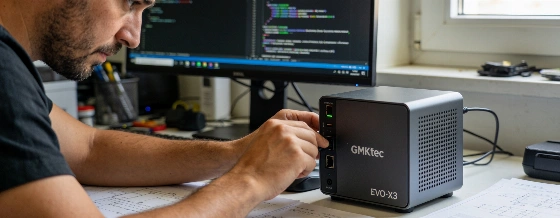
GMKtec EVO-X3 turns the mini PC into a serious local AI machine, with 128GB unified memory and AMD Ryzen AI Max+ 395. It offers top-tier performance, but only for those ready to handle a demanding setup and software quirks.
The GMKtec EVO-X3 is built for users who want real AI performance on their own hardware, not in the cloud. This mini PC is aimed at people who know their way around complex systems. With 128GB of unified LPDDR5X-8000 memory (soldered and non-upgradable) and an AMD Ryzen AI Max+ 395 processor (16 cores, 32 threads, up to 5.1 GHz), plus Radeon 8060S graphics (40 compute units) and a 50-TOPS XDNA 2 NPU, it delivers more power than most compact workstations. The system's total AI performance is rated up to 126 TOPS, putting it among the most capable local AI mini PCs available.
The EVO-X3 is designed for local AI workloads. While cloud models still offer more scale, this machine lets you run demanding AI agents and models without ongoing fees or privacy concerns. Developers and creative professionals who are willing to invest time in building custom workflows will find a system that can change how they work-if they can get through the setup process.
Hardware che rompe gli schemi
The EVO-X3 measures 353 x 186 x 41mm and weighs about 2.3kg. Its tall, vented metal case is practical and built for cooling. The ports cover the basics: USB 3.2 Gen 1, USB 2.0, and 3.5mm audio on the front; HDMI 2.1, USB4 40Gbps, USB 3.2 Gen 2, OCuLink PCIe 4.0 x4, and 2.5GbE RJ-45 on the back. The OCuLink port (PCIe 4.0 x4) allows direct connection of external GPUs, a feature that sets the EVO-X3 apart from most other mini PCs and is noted in independent reviews. The cooling system stays quiet even under heavy use, which is rare for this much power in a small case. The external 230W power supply meets the system's high power needs.
Benchmarks show strong results: CPU, GPU, and NPU performance are excellent once the system is set up correctly. The 128GB memory limit is a major advantage for local AI, letting you load and run models that would overwhelm smaller machines. The integrated GPU can use up to 96GB of system memory, which helps with AI and graphics tasks. Windows 11 Pro comes pre-installed, but Ubuntu and Linux are also supported for those who prefer open-source systems. Storage is flexible, with two M.2 2280 PCIe 4.0 x4 slots supporting up to 16TB total, and retail models often include 2TB or 4TB SSDs.
"La piattaforma EVO-X3, con la sua memoria LPDDR5X-8000 da 128GB e il processore Ryzen AI Max+ 395, rappresenta un salto generazionale per l'elaborazione AI locale, offrendo prestazioni che fino a poco tempo fa erano riservate a workstation di fascia alta." Esperto hardware QWERTYmag, Analisi tecnica
Software e ostacoli di configurazione
The EVO-X3 comes with the Claw local-AI environment, which advertises one-click deployment of models and agents. In reality, users will run into bugs and bottlenecks that often require switching to other AI management tools like Lemonade to get the most out of the NPU. The included software is ambitious but not yet smooth, and reaching full performance takes patience and technical skill.
For those who manage the setup, the rewards are real: local AI agents that can automate and speed up complex tasks, all without sending sensitive data to the cloud. But the learning curve is steep, and the documentation is lacking. This is a workstation for people who like to build and tinker, not for those looking for a simple out-of-the-box experience.
Prezzo e pubblico di riferimento
The 128GB/2TB version of the EVO-X3 costs $3,799.99, aimed at professionals who know exactly what they want. It's not a general-purpose desktop or a casual AI gadget. The target users are experienced developers, AI researchers, and creative professionals who need local control and are willing to pay for it. Compared to other mini PCs, like those discussed in our previous analysis, the EVO-X3 gives up some connectivity and ease of use in exchange for raw AI power and memory capacity.
The strengths are clear: unmatched AI performance in a mini PC, huge unified memory, and quiet cooling. The downsides are just as obvious: a high price, limited ports, and software that needs hands-on work. As of September 2026, the EVO-X3 is available in Japanese and European stores, with prices that can change a lot due to promotions and currency shifts. In one case, a clearance sale listed it at 10.7 million yen, showing both its premium status and market swings. Italian buyers should keep an eye on AGCOM regulatory updates for AI hardware imports and compliance.
The GMKtec EVO-X3 is a bold entry in the mini PC market. It offers local AI performance that was once limited to high-end workstations, but it demands technical skill and a willingness to deal with setup challenges. For those who can handle its quirks, it opens up new possibilities for local AI work. For everyone else, it may prove more trouble than it's worth.