
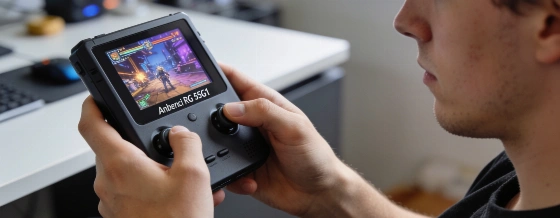
Anbernic debuts its RG 55G1 handheld powered by the Snapdragon G1 Gen 2, promising strong PSP emulation but revealing critical GPU weaknesses that limit its appeal against rivals in the same price range.
The Anbernic RG 55G1 arrives with big promises, but its graphics performance quickly reveals the device's limits. This is Anbernic's first handheld with a Qualcomm Snapdragon G1 Gen 2 chip, a move that was meant to boost the brand's standing among emulation fans. Instead, it highlights the company's ongoing struggle to deliver a well-rounded device.
On the surface, the RG 55G1 looks promising. The 5.5-inch 1920×1080 IPS touchscreen is sharp and colorful, and the build feels solid for a 340-gram handheld. The glass front adds a premium touch, though it also makes the device more fragile. The textured plastic shell helps with grip, but the flat back isn't comfortable for long gaming sessions.
Performance and hardware limits
The Snapdragon G1 Gen 2 inside the RG 55G1 is built on a 4 nm process and uses an octa-core Kryo CPU (2 performance cores up to 2.4 GHz, 6 efficiency cores up to 2.0 GHz) with an Adreno A12 GPU. This is a shift for Anbernic, which usually relies on non-Snapdragon chips. In practice, the results are mixed. The Adreno A12 GPU struggles with some Geekbench 6 Vulkan tests and can only handle lightweight Android games. Emulation is better: Dreamcast, Saturn, N64, and especially PSP run smoothly at native resolutions. But the device can't keep up with more demanding systems-Wii, PS2, and GameCube only work at their lowest settings, and Switch or Wii U emulation isn't possible.
Battery life is a bright spot. The 6000 mAh battery can last up to eight hours, and the fan is nearly silent, a welcome change from the noisy RG Vita Pro. The device stays cool even during long sessions. It supports 18 W charging over USB-C and includes Wi-Fi 5 and Bluetooth 5.0, but lacks newer standards like Wi-Fi 6 or 5G, which are now common in other handhelds.
Qualcomm's G1 Gen 2 was designed for dedicated gaming handhelds, but its graphics performance has drawn skepticism from reviewers comparing it with competing budget handhelds.
- YouTube review summary (source)
Controls and display
The controls are uneven. The Hall Effect sticks are accurate but sit too low, forcing a claw grip that gets uncomfortable quickly. The stacked shoulder buttons and analog triggers respond well, but the face buttons and d-pad are stiff and lack the satisfying feel of Anbernic's better models. The display isn't OLED, but it avoids the PWM flicker issues seen in earlier devices and stays bright enough for most situations.
Software and usability
On the software side, the RG Home frontend now works more smoothly with Android apps, and the RG Control Center overlay makes it easy to adjust performance and remap controls. However, the device comes loaded with bloatware, and users can't choose which apps to install. Early development of Rocknix for the RG 55G1 suggests future improvements, but for now, the experience is inconsistent.
Price and competition
The RG 55G1 launches at $139.99 for the 4 GB/64 GB version and $164.99 for the 8 GB/128 GB model, with regular prices at $149.99 and $174.99. This puts it up against other handhelds that offer stronger GPU performance and more flexible aspect ratios. For PSP emulation, the RG 55G1 is Anbernic's best so far, but anyone looking for broader emulation will find better options elsewhere. For official pricing and specs, see the VideoCardz launch report.
Other compact PCs and handhelds set a high bar. As reported earlier, even mini PCs like the GEEKOM IT13 MAX now offer better connectivity and performance, showing how much ground Anbernic still needs to cover.
Despite some progress in build quality and software, the RG 55G1's weak GPU keeps it in a niche for PSP fans rather than as a true all-in-one emulation device. Anbernic has taken a step toward Qualcomm-powered handhelds, but until it solves its performance issues, the RG 55G1 is more a lesson in missed potential than a breakthrough.