
ASUS ExpertCenter Pro ET900N G3 shakes up the AI desktop market with its Grace Blackwell Superchip, titanium-grade power supply, and smart cooling, matching the MSI WS300 on speed but adding real-world improvements.
ASUS has stepped up in the AI workstation field with the ExpertCenter Pro ET900N G3. This GB300 DGX Station doesn't just match rivals-it changes what you can expect from a deskside AI machine. The numbers tell the story: vLLM throughput is within 2% of the MSI WS300 on most models and workloads. But ASUS stands out with its design and usability.
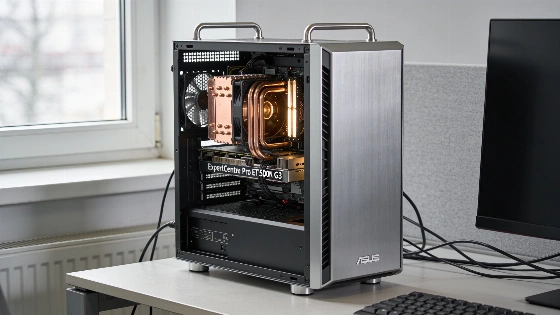
The ET900N G3 runs on NVIDIA's Grace Blackwell Ultra Desktop Superchip. This fixed platform packs 72 Grace cores, a B300 GPU, 252GB of HBM3e, 496GB of LPDDR5X, and a ConnectX-8 SuperNIC with two 400GbE ports. ASUS leaves the core silicon untouched, but the hardware build is anything but standard. The brushed silver case, dark mesh front, and chrome details aren't just for looks. They show ASUS's focus on both style and function. Two strong metal handles on top turn this 27kg tower into a portable AI lab. MSI's WS300 doesn't offer this kind of mobility.
Cooling is where ASUS shows its engineering skills. The GB300 Superchip sits under copper cold plates. SOCAMM modules and the ConnectX-8 card also get liquid cooling. ASUS knows 400G optical transceivers run hot, so they add a dedicated fan above the ConnectX-8 cold plate. This fan blows right onto the QSFP112 optics cages. It's a direct fix for a real problem-one that other systems haven't solved as well.
Power delivery gets a major boost too. The ET900N G3 uses a 1,600W 80 PLUS Titanium-rated power supply. This beats the Platinum unit in the WS300, cutting energy waste and giving steadier power during heavy AI inference. Storage comes from two 2TB NVMe drives in RAID 1 for boot, with room to expand. The review unit shipped with an NVIDIA RTX PRO 2000 GPU, but users can remove it to let the Superchip handle all the acceleration.
ASUS ExpertCenter Pro ET900N G3 is designed as a deskside AI supercomputer, delivering up to 20 PFLOPS of AI performance and 748 GB of coherent memory, enabling enterprises to develop, fine-tune, and run large AI models locally without cloud dependency.
Benchmarks back up ASUS's claims. The ET900N G3 is strong at serving large models with coherent memory offload. In some cases, it beats multi-GPU setups. On shared models, it delivers 2.8 to 3.4 times the throughput of a single RTX PRO 6000, and 1.7 to 3.7 times that of an H200 NVL at full concurrency. These aren't small gains-they show a big jump in what's possible for local AI inference on one workstation.
ASUS also makes the machine easier to use. The top handles might seem like a small thing, but anyone who's tried to move a 27kg tower knows how much it helps. The front panel has plenty of USB ports and audio jacks. The rear panel keeps workstation I/O separate from server hardware. This setup makes real-world deployment simpler. ASUS's cooling approach lines up with what was seen in the recent review of the ASUS ROG Strix SLC IV 360 ARGB LCD, where practical engineering meets the needs of enthusiasts.
The ET900N G3 doesn't just keep up with the MSI WS300. It brings real improvements for professionals running tough AI workloads on site. With advanced cooling, a titanium-rated power supply, and user-focused design, this workstation is a strong contender for the Best Desktops for Local AI list. ASUS shows that smart hardware design can deliver both top performance and real-world advantages, setting a new bar for deskside DGX Stations.
ASUS's official documents confirm the ET900N G3 is built for local deployment and fine-tuning of large models. It supports LLM inference, multimodal AI, and autonomous AI agents, and can handle models up to 1 trillion parameters. This makes it a smart pick for organizations that want to keep control of their data and follow European AI rules, including those from AGCOM and the Garante Privacy authority.