

The Kubuntu Focus Ar Gen 1 aims for top-tier Linux performance and a light frame, but old hardware, shaky build, and odd keyboard choices make its steep price hard to swallow.
Unboxing a $2,125 laptop should feel like opening something special. The Kubuntu Focus Ar Gen 1 doesn't deliver. Right away, you see a Copilot key that does nothing on Linux and a case that feels like it belongs in 2016.
At this price, you expect solid hardware. The Focus Ar Gen 1 falls short. The keyboard, sold as "no-flex," bends with little pressure. It feels like a cheap laptop from years ago. The trackpad is just as bad. It uses a tilt mechanism that makes right-clicking tricky and unreliable. For Linux fans and pros, these aren't small issues. They're dealbreakers.
Build quality misses the mark
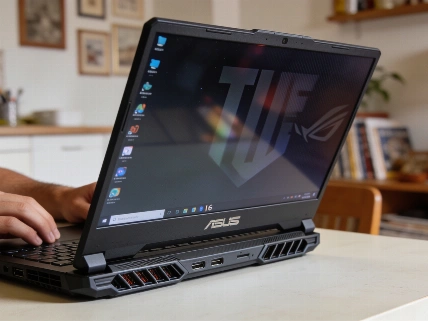
The Focus Ar Gen 1 is light at 3.13 pounds (1.42 kg). But that lightness comes with a flimsy feel. The chassis and screen both flex more than they should for a laptop in this class. The 16-inch matte IPS display has a 2560×1600 resolution and a 165Hz refresh rate, but the screen still feels weak. The Copilot key, meant for Windows AI, is pointless here. It just acts as a regular key. With a keyboard already set up for Kubuntu, this choice makes even less sense. It feels like the hardware was put together without thinking about who would use it.
The ports look good on paper: two USB-C (one Thunderbolt 4), two USB-A, HDMI 2.0, microSD, and a headphone/mic jack. But the details disappoint. Both USB-C ports sit on the same side. Only one gives you Thunderbolt 4 speeds. The other tops out at 10 Gbit/s. That's a letdown, especially since the Intel Core Ultra X7 358H could do more. The HDMI port is stuck at 2.0, so you only get 4K60 output. Apple laptops at lower prices offer 4K144. These choices make the Focus Ar Gen 1 feel stuck in the past.
Официальный конфигуратор Kubuntu Focus Ar Gen 1 указывает стартовую цену от $1,950, а базовая версия идет с 500 ГБ SSD; более дорогая конфигурация, близкая к рассматриваемой в обзоре, продается заметно выше этой отметки.
Linux setup and real-world speed
The Focus Ar Gen 1 does well with its software. Kubuntu 26.04 LTS comes pre-installed and ready to go. The setup wizard walks you through encryption, extra software, and tweaks. You can get started fast, without the bloat or hassle of a Windows install. The Kubuntu Focus Suite adds a few tools, but the main draw-Linux out of the box-is easy to get on almost any new laptop.
Everyday use feels quick. The Intel Core Ultra X7 358H and 32GB of LPDDR5X RAM are top specs for a thin Linux laptop. But benchmarks tell a different story. Geekbench 6 scores were 12.9% lower than the maker's claims for single-core, and 16.6% lower for multi-core. Unigine Superposition results were over 20% below what was promised. The built-in Intel Arc B390 GPU is fine for daily work but weak for gaming or heavy graphics. One bright spot: you can swap out the SSD, battery, fan, and Wi-Fi modules. That's rare in this price range.
Display and day-to-day use
The 16-inch matte screen is the Focus Ar Gen 1's best feature. With 2560x1600 resolution and 165Hz refresh, it's smooth and glare-free. The 16:10 aspect ratio works well for getting things done. Colors are accurate enough for most people, but if you need perfect color for editing photos or video, you'll want something else. The light build makes it easy to carry, but you pay for that with a case that doesn't feel sturdy.
How it stacks up to the competition
The Focus Ar Gen 1 starts at $1,950, and the tested version costs $2,125. That's a tough sell. For a bit more, you can get a Lenovo Yoga Pro 9i with a Core Ultra 9, up to 64GB RAM, and a dedicated NVIDIA GPU. You can install Linux yourself. The Focus Ar Gen 1's only real edge is Linux pre-installed, but as shown in our recent coverage of other productivity laptops, hardware quality and smart design matter more than pre-loaded software.
If you want a premium, light, and repairable Linux laptop, the Kubuntu Focus Ar Gen 1 falls short. The display and software setup are good, but old hardware, weak build, and strange keyboard choices make it a bad deal at this price. Even budget laptops now offer better build quality. Kubuntu Focus needs to rethink what a true premium Linux laptop should be.