
Valve's Steam Frame VR headset arrives to critical acclaim for its hardware but leaves reviewers split on who should actually buy it, while a wave of new monitors, SSDs, and CPUs compete for attention in a market where price and platform matter more than ever.
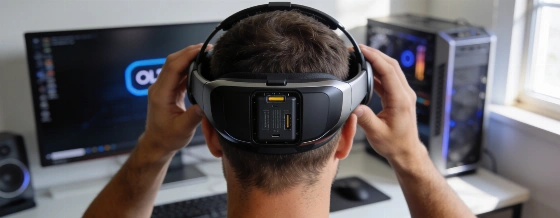
Valve's Steam Frame is finally in the hands of reviewers, and nearly everyone agrees the hardware is impressive. The $1,059 headset is lighter than the Quest 3, and the rear battery pack helps balance the weight-unless you wear glasses, in which case comfort drops off. The real debate is about who should actually buy it. Road to VR highlights its flawless tracking and a surprisingly capable standalone mode, but points out that demanding games still require a powerful PC. Kotaku ran into Wi-Fi issues and found the headset spent more time updating than playing games. Aftermath notes that features like gamepad streaming and Linux dongle support aren't ready yet. The 256 GB model starts at $1,059 (about €1,049 in Europe), with a 1 TB version at $1,299. There's also a $60 ergonomics kit that most reviewers consider a must-have. Reservations are handled through a queue or lottery in several regions, showing Valve's cautious approach to hardware launches.
Inside, the Steam Frame runs SteamOS 3 on a Snapdragon 8 Gen 3 chip, with 16GB of LPDDR5X RAM and either 256GB or 1TB of UFS storage, plus a microSD slot. The headset uses dual 2160×2160 LCD panels with inside-out tracking and supports refresh rates from 72Hz up to 144Hz (the highest setting is experimental). At 440 grams, it's lighter than most competitors, which has earned it praise for comfort in early reviews. Valve has focused on wireless performance, building in Wi-Fi 7 and including a Wi-Fi 6E adapter for PC streaming, so it can be used both standalone and tethered.
Elsewhere in hardware, the AMD Ryzen 7 9800X3D is under review. At $479, the Zen 5 X3D chip delivers 10-12% higher average frame rates at 1080p compared to its predecessors, with some games like Hogwarts Legacy seeing a 25% jump. The biggest gains are in 1% lows: Alan Wake 2, Cyberpunk 2077, and Stalker 2 improve by 21-36%. Outside gaming, the 9800X3D posts 30-33% better multi-core and 20-30% better single-thread performance. Efficiency is up, but Club386 reminds anyone upgrading from a 5800X3D that you'll need a new AM5 board and DDR5 RAM, which changes the value calculation.
Monitors are also competing for attention. The Gigabyte MO32U24, with its Samsung QD-OLED panel, reaches 299 cd/m² full-screen SDR and covers 99.19% of DCI-P3. At 140 PPI, text clarity is no longer a weakness for OLED, and after a quick OSD adjustment, grayscale accuracy is excellent. The main drawback is a USB-C port that limits the KVM, making the $1,000 price harder to justify if you need single-cable laptop setups-especially since the MSI MPG 322UR X24 offers more for $99 extra. Meanwhile, iiyama's G-Master GOB2701QSC is a surprise value: a 27-inch 1440p 280 Hz OLED at a temporary £299, undercutting rivals with the same LG panel. That price ends after September 27, but even at its regular £420, it's the most affordable Tandem OLED in its class, with 65 W USB-C power delivery and a matte coating that trades a bit of sharpness for better reflection handling.
Storage is shifting too. Sandisk has put its name on the Optimus GX Pro 8100 2 TB SSD, but TechPowerUp points out it's the same drive as the WD Black SN8100, just rebranded. Performance is still top-tier, with a large SLC cache and efficient operation, but the $550 price for 2 TB is hard to ignore. Team Group's T-Create Expert P34F 1 TB is an SSD with a built-in AirTag. Apple Find My support works well, but you're paying $238 for a 10 Gbps drive, and PCWorld's early sample had a battery contact issue that needed a replacement. For anyone who's lost too many drives, the tracker might be worth the extra cost.
Motherboards are getting updates. The ASUS B850 NEO line balances new features with higher prices. The ROG Strix B850-A Gaming Wi-Fi7 Neo adds faster Ethernet, more USB ports, and a whiter look, but TechPowerUp questions the $60 premium-especially since it drops from two video outputs to one, which matters for iGPU builds. Overclockers.com finds the TUF Gaming B850I WiFi Neo to be the cheapest Mini-ITX board that can handle high memory speeds, with solid RAM compatibility and no stability issues, all at $272.79 and likely to drop further.
Power supplies are in the mix as well. The be quiet! Dark Power Pro 14 IO 1300W has Cybenetics Titanium certification, delivers full power at 45°C, and comes with two 12V-2×6 connectors rated for 600W each. Noise is low, hold-up time is good, and the ten-year warranty is a plus. The main issues are ripple suppression and a 3.3V rail that exceeds transient limits without output capacitors, but these don't show up in real builds. Fan-failure protection is missing, but HWBusters sees these as minor refinements.
MSI's MEG Maestro 900R case is built for frequent builders. The rotating, removable motherboard tray turns the chassis into a workstation, and the panoramic glass design puts every component on display. There are five USB Type-C ports up front, support for large radiators, and a PCIe 5.0 riser included. At 30-33 kg empty and nearly $700, it's heavy and expensive. GeekaWhat notes that the 60W power delivery on the front I/O only works with an MSI board, so check compatibility before buying.
On the software side, Remedy's Control Resonant won't render natively on any GPU. Every setting uses DLSS or FSR, with DLAA and FSR Native AA as the closest to 100% scaling. TechPowerUp's 35-GPU test shows that 1080p at 60 FPS with max settings needs at least an RX 7800 XT, RTX 5070, or RTX 4070 Ti, and 1440p requires even more. Path tracing is hidden behind the "Indirect Lighting" label and is enabled on every ray tracing preset, including Low. Radeon cards can run path tracing, but the RT Ultra preset is locked to NVIDIA hardware. Intel's Arc A770 crashes on map load, and XeSS isn't available. The settings menu's labels are misleading and could cost users performance until they figure out what's actually being enabled.
For those following compact PCs, the Minisforum M2 Pro set a new standard for small form factor power, but the latest hardware launches show that every segment-from VR to SSDs to motherboards-now comes down to the details: platform costs, missing features, and the reality that great hardware is only as good as the software and support behind it. The Steam Frame is a clear example: a technical achievement that leaves buyers wondering not just what it can do, but whether it's worth buying now or waiting for the rest of the ecosystem to catch up. In a market full of caveats, the fine print matters more than ever.