
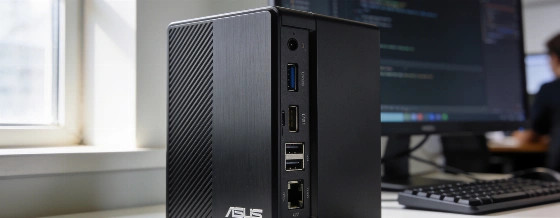
The ASUS Ascent QN10 is the first Arm-based mini PC to outpace x86 competitors, packing 18 Oryon cores and an 80 TOPS NPU into a 0.7-liter chassis. Built for AI developers and edge deployments, it shows just how much a compact desktop can do.
Mini PC performance claims often fall apart under real testing, but the ASUS Ascent QN10 changes that. For the first time, an Arm-based desktop not only keeps up with x86 rivals but pulls ahead, thanks to Qualcomm's Snapdragon X2 Elite and an 80 TOPS NPU-all in a case smaller than a lunchbox.
The QN10's 18 Oryon cores (up to 4.7GHz) and Adreno X2-90 GPU deliver a 43% to 76% lead over the NUC 14 Pro in CPU benchmarks, and nearly double its graphics scores. These aren't just lab numbers: in real AI workloads, the Hexagon NPU scores 5,457 in SD 1.5 image generation and 35.7 tokens per second on Phi, with the CPU barely breaking a sweat. The result is a Copilot+ desktop that stays quiet, even under load, and draws little power at idle.
ASUS has packed in plenty of connectivity and cooling. The QN10 includes a vapor chamber, a dedicated fan for the PCIe Gen5 SSD slot, seven USB ports (three USB4), HDMI 2.1, 2.5GbE, Wi-Fi 7, and support for four 4K displays, all in a 0.7-liter frame. Security features include fTPM 2.0 and Qualcomm's SPU with Microsoft Pluton support, making it a solid choice for enterprise and edge deployments where data security matters.
The Ascent QN10 is officially the world's first 80 TOPS AI mini PC, built on the Snapdragon X2 Elite X2E-88-100 platform and now available for purchase, as confirmed by ASUS. It supports up to 32GB of LPDDR5x memory and offers two M.2 slots (PCIe Gen5 NVMe and PCIe Gen4 NVMe) for up to 4TB of storage, all in a chassis under 0.7 liters. The US starting price is $1,349 for the 16GB/512GB version, while the 32GB/512GB model is listed at $1,699, reflecting its focus on AI and edge workloads.
ASUS positions the QN10 as a device for exceptional performance, responsive AI experiences, and outstanding energy efficiency, targeting AI-centric workloads rather than just compact desktop use.
The QN10 is aimed at AI developers, prosumers, and edge scenarios like digital signage, kiosks, and computer vision in industrial or retail settings. With Qualcomm AI Hub integration, ready-to-run models are easy to deploy, and always-on assistant workloads suit the hardware well. The 16GB/512GB version is listed at $1,349.99, while the 32GB build (tested here) is currently out of stock, showing strong demand among early adopters.
Windows-on-Arm compatibility is still evolving, with native support limited to certain applications. Buyers should check their software needs before committing, as not every tool will run natively or at full speed. This is a familiar issue for Arm desktops and remains a practical limitation alongside the QN10's technical advances.
Strengths and trade-offs in a small package
The QN10's hardware shows what's possible in a mini PC, but there are trade-offs. The 32GB of LPDDR5x memory is soldered and can't be upgraded, so buyers are locked into their initial choice-a tough ask at this price, especially when x86 competitors like the NUC 15 Pro offer full memory and storage flexibility for around $700 (barebones). Storage is mixed: the included 512GB Gen4 SSD is slower than even the previous Neo 50q, though the empty Gen5 slot allows for user upgrades.
For those who need a quiet, efficient, always-on AI device, the QN10 is a strong option. Its edge inference abilities, capable NPU, and compact design make it well-suited for signage, kiosks, and developers using the Qualcomm AI Hub. Its performance-per-watt and security features are appealing for enterprise and industrial buyers who want local inference without relying on the cloud.
Comparisons and the new Arm reality
The QN10's lead over x86 competitors isn't just about specs. In direct benchmarks, it leaves the NUC 14 Pro behind and more than doubles the performance of the previous Snapdragon-based Neo 50q, depending on the test. This is one of the first times Arm hardware doesn't just compete on efficiency-it wins on speed and capability. For comparison, the GMKtec EVO-X3 also targets local AI workloads, but with a different approach and audience.
ASUS has delivered a mini PC that finally makes Arm a real contender on the desktop. The QN10's fixed memory, storage quirks, and Windows-on-Arm's patchy software support are real limitations, but they don't overshadow the breakthrough. This is the first Arm mini PC that doesn't force users to compromise on performance, and it sets a new standard for edge and developer desktops. For those waiting for an Arm system that can truly challenge x86, the Ascent QN10 is the answer.