
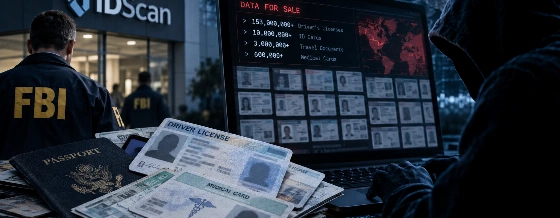
IDScan faces a legal and reputational crisis after hackers allegedly stole and tried to sell over 153 million driver's licenses. Lawsuits and federal investigations are mounting, with the scale of the breach raising urgent questions about data security in the identity verification industry.
More than 153 million driver's licenses, along with millions of other sensitive documents, are now at the center of a legal and cybersecurity storm engulfing IDScan. The company, a major player in identity verification technology, is facing a barrage of lawsuits and federal scrutiny after hackers allegedly breached its systems and offered the stolen data for sale on the dark web.
The FBI's New Orleans office has confirmed it is investigating the incident, a rare public acknowledgment that underscores the gravity of the breach. Reuters independently verified the federal probe, while BleepingComputer received confirmation from the agency, though the FBI declined to provide further details due to the ongoing nature of the case.
Unprecedented scale and exposure
The breach first came to light when cybersecurity journalist Brian Krebs reported that a dark-web service called "Nexus" was advertising access to a trove of personal data: over 153 million U.S. and Canadian driver's license scans, 10 million ID cards, 3 million travel documents, and nearly 600,000 medical cards. Krebs personally verified the authenticity of the leak by searching for his own records and those of consenting individuals, tracing the source back to IDScan.
Among the compromised records, BleepingComputer learned that documents belonging to high-profile figures-including U.S. Secretary of Defense Pete Hegseth and an assistant director of the FBI-were present in the database, though this information could not be independently confirmed. The illegal Nexus service has since vanished from the dark web, but the stolen data remains in circulation among cybercriminals.
Legal backlash and industry fallout
Law firms such as Markovits, Stock & DeMarco and Hall Attorneys have launched investigations and filed lawsuits in Louisiana, where IDScan is headquartered. The suits allege that IDScan failed to adequately protect the sensitive information of its clients, which include major brands like Hertz. According to Markovits, Stock & DeMarco, IDScan began notifying some business customers around September 1, but the full scope of affected individuals remains unclear.
The lawsuits are seeking to organize potential class-action cases, targeting not only IDScan but also the broader ecosystem of businesses that relied on its technology to scan and authenticate government-issued IDs. With the scale of the breach, legal experts anticipate that additional lawsuits could be consolidated into multidistrict litigation, amplifying the pressure on IDScan and its partners.
Regulatory scrutiny and industry parallels
State attorneys general and federal regulators are now weighing possible enforcement actions, a scenario that has played out in other high-profile data breaches involving companies like 23andMe, Marriott, and Equifax. The IDScan incident has reignited debate over the security standards of identity verification providers, especially as their systems are widely used in sectors ranging from car rentals and retail to financial services and cannabis dispensaries.
For context, the scale and sensitivity of this breach echo the magnitude of other recent data exposures, such as the McKesson incident reported earlier this year, where millions of patient records were compromised through third-party applications.
Silence from IDScan and unanswered questions
Despite the mounting legal and regulatory pressure, IDScan has yet to issue any public statement addressing the allegations or clarifying the extent of the breach. The company did not respond to repeated requests for comment from BleepingComputer. This silence leaves clients and consumers in the dark about whether their personal information is at risk and what steps, if any, are being taken to contain the fallout.
As lawsuits multiply and federal investigators dig deeper, the IDScan breach exposes a glaring vulnerability at the heart of the digital identity industry. When a company trusted by banks, retailers, and government agencies cannot guarantee the security of the very documents it is paid to protect, the entire sector's credibility is on the line. The lack of transparency from IDScan only compounds the damage, signaling a leadership vacuum at the worst possible moment. Until the company confronts the crisis head-on and regulators enforce real accountability, millions remain exposed-and trust in digital identity verification hangs by a thread.