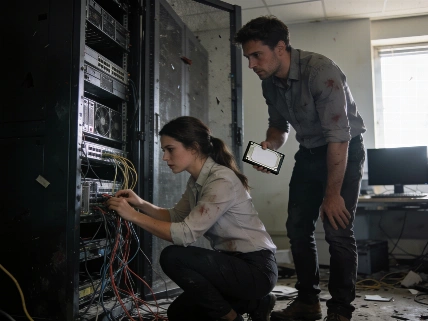


Ransomware attacks now threaten hospitals and critical infrastructure, putting lives at risk. Experts explain why zero trust is essential for older adults, families, and organizations facing constant digital threats.
Picture a hospital brought to a halt by ransomware-not for ransom, but simply to destroy. Patient records are locked, medication data disappears, and staff are left without the information they need. Dr. Christopher Whyte says this is no longer a distant scenario. "They're not looking for money. They're just looking to encrypt the data, and they'll never give you the key, at which point they've destroyed the data," he explains. The fallout isn't just financial; it can be life-threatening.
For older adults and families, the threat hits close to home. One wrong click can lock away family photos, empty bank accounts, or leak private details. Katherine Ambrose, who coaches older adults on aging well, says she now treats every unknown caller as a possible scammer. "I sometimes feel bad about how I answer the phone because I assume callers are scammers," she says. Amy O'Rourke, an aging expert, describes her own shift: "I've gotten so many texts that I know are fraudulent. My husband got one. He forwarded it to me to respond, and I just called him and I said, 'We can't trust anyone. We can't.'"
Il cuore della zero trust
Zero trust isn't just a buzzword-it's a new way to defend against digital threats. Dr. Whyte puts it simply: "Never assume you are safe because of the security steps you have already taken." In practice, this means treating every device, request, and interaction as untrusted until proven otherwise. The approach is spreading as attacks grow more sophisticated, especially with artificial intelligence in the mix. "Your average person tends to think about the personal safety piece of it, but they're strongly connected," Whyte says, pointing out how personal and organizational risks now overlap.
Sam Cradduck, a gerontologist, has changed her habits. She ignores calls from numbers she doesn't recognize and checks every delivery notification carefully. "I don't answer my phone unless you text me and say, 'Hey, I'm going to call you,' or if you're already in my contacts," she says. Dr. Rhea Rogers, a physician, refuses to reply to suspicious delivery texts. "I'm like, nope," she says, showing how much caution is now part of daily life.
Le raccomandazioni ufficiali per la resilienza informatica nel settore sanitario promuovono esplicitamente il modello zero trust come parte integrante della protezione di base, in linea con il NIST Cybersecurity Framework e le misure per la difesa delle infrastrutture critiche.
Agenzia per la Cybersicurezza Nazionale (ACN), Regolatore nazionale italiano (link)
Attacchi alle infrastrutture e modelli globali
The Medusa ransomware group has already hit more than 300 major organizations, from hospitals to manufacturers. The Department of Homeland Security warns these attacks are just the start. Whyte points to the European Union's new AI Act as a model for regulating digital risk: "The European Union has passed their AI act recently, which is the first, global, major regulation that deals with the regulation of AI based on risk categories."
Critical infrastructure is now a main target for both criminals and nation-state hackers. In 2025, healthcare and public health made up the largest share of ransomware incidents among critical infrastructure sectors, with 460 out of 2,118 attacks, according to FBI IC3 data. This spike has led Italian and European regulators to step up guidance on cyber hygiene and zero trust, following the NIST Cybersecurity Framework and the latest NSA best practices. These stress the need for multi-factor authentication, keeping an up-to-date inventory of devices, patching systems quickly, and segmenting networks with constant monitoring. The Italian Garante Privacy has also issued specific advice for healthcare providers to comply with GDPR and reduce the risk of ransomware-related data breaches.
As reported earlier, even advanced malware like SloppyRAT is getting past standard security tools, letting ransomware spread inside organizations. The mix of AI, new tech, and cybercrime is creating gaps that old defenses can't cover, especially as 5G and Wi-Fi 6E networks widen the attack surface in hospitals and smart homes.
Adattarsi o soccombere
Whyte is blunt: cybersecurity lessons keep changing, and so do the attackers. Zero trust isn't about paranoia-it's about survival in a world where trust can be dangerous. For families, businesses, and especially older adults, this mindset is now a necessity. In 2025, adults over 60 filed more than 201,000 complaints to the FBI IC3, with losses close to $7.7 billion. In government impersonation scams, seniors made up 51.8% of all monetary losses. The Federal Trade Commission and Italian authorities advise checking calls through official channels, avoiding suspicious links, and contacting your bank right away if you spot unusual activity. The era of digital innocence is over. Those who stick to old habits are at risk; those who adapt have a chance.