
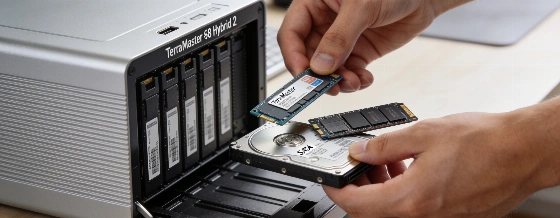
The TerraMaster D8 Hybrid 2 puts four SATA bays and four NVMe SSD slots in a single USB enclosure. It offers a rare mix of capacity and speed for anyone looking to reuse old drives, but the lack of full RAID and a shared 10 Gbps link set clear limits.
Mixing hard drives and SSDs in one small box is now possible for anyone with leftover drives and not much room in their PC. The TerraMaster D8 Hybrid 2 does just that. It gives you four SATA bays and four NVMe SSD slots, all through one USB cable. If you have drives left over after shrinking your setup, this box lets you use them again-without the hassle of a full NAS.
This flexibility comes at a cost. The D8 Hybrid 2 sells for $299.99 with no drives included. That's a lot for a USB enclosure. The main appeal is simple: you can put big hard drives in for archiving and fast SSDs for active work, all in one place. TerraMaster says you can reach up to 152 TB of raw storage, though most people won't get close to that. For most users, it's about keeping video, photos, and games local, using drives you already own.
Easy setup and access
Getting the D8 Hybrid 2 running is simple. The front trays let you swap SATA drives quickly. A side panel comes off to reach the NVMe slots. Moving drives from an old system takes just a few minutes. After three weeks of daily use, the box stayed stable and quiet. The fan barely made a sound, even during long video transfers. Heat and crashes were never a problem. The only real noise came from the hard drives, not the enclosure itself.
Performance and technical limits
TerraMaster lists read speeds up to 1,020 MB/s with a single NVMe SSD. Real-world tests with a PCIe Gen3 x4 NVMe drive hit about 960 MB/s. The SATA drives moved data at around 140 MB/s. Both numbers show the effect of the shared 10 Gbps USB 3.2 Gen2 port. The D8 Hybrid 2 is sold as a disk enclosure, not a NAS. European stores list it at about 1399,00 zł in Poland, which is a good reference for EU buyers. RAID support is limited: only the first two SATA bays can use hardware RAID. The other two SATA slots and all four NVMe slots show up as separate drives. If you want redundancy, you'll need to set it up in software or on your computer.
The D8 Hybrid 2 is an 8-drive hybrid DAS: 4 front SATA bays plus 4 M.2 NVMe slots, with the NVMe area accessed by removing a side panel. Only the first two SATA drives can be used in RAID, while the rest are exposed as individual pools.
If you store photos or footage you can't replace, the lack of built-in redundancy is a real drawback. Mirroring is no substitute for a real backup. The 10 Gbps USB-C port is fast, but all eight drives share that speed. Adding more SSDs won't make transfers faster. This is direct-attached storage, not a networked NAS, and it doesn't have the advanced data protection you get in business gear. If you need to follow Italian or EU data rules, like those from Garante Privacy, you'll need to plan carefully and keep backups outside the box.
How it stacks up against other compact options
Most small storage boxes force you to give up expandability. The D8 Hybrid 2 stands out because it lets you use both SATA and NVMe drives together. This is similar to what the GMKtec EVO-X3 does for mini PCs, as covered by QWERTYmag in their recent report. Both products are for people who want to get the most out of hardware they already have, without losing speed or flexibility.
Editorial verdict
The TerraMaster D8 Hybrid 2 isn't for everyone. Its price and limited hardware RAID will turn off anyone looking for a simple backup box. But if you have a mix of SATA and NVMe drives collecting dust, or you need both lots of storage and SSD speed in one box, it fills a gap that few other products do. The shared 10 Gbps bandwidth is a bottleneck, and the lack of built-in redundancy means you have to plan your backups. Still, for the right user, the D8 Hybrid 2 does what it promises: it gives you practical, flexible storage expansion without extra hassle. In a market full of one-size-fits-all boxes, that's a welcome change.